
Fresh vs cryopreserved: what changes and what to test for
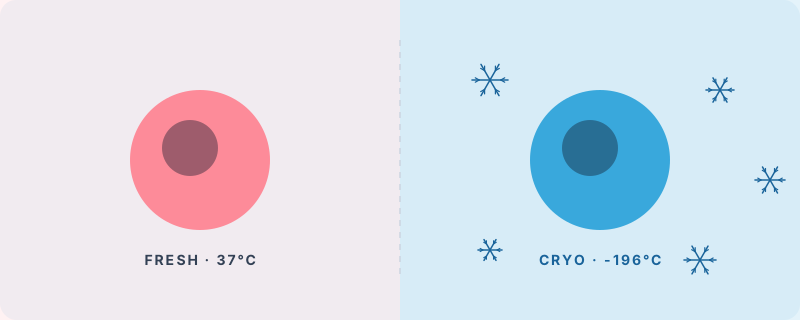
The convenience of cryopreserved cell preparations is real — they ship globally, they reserve known-good characterization, they fit a research timeline that does not depend on a donor showing up on the right Tuesday. The trade-off is that cryopreservation changes things. Some of those changes resolve within hours; some do not resolve at all. Knowing which is which makes the difference between a clean experiment and a confounded one.
What measurably changes after a freeze-thaw cycle
- Membrane integrity. Even with optimal cryoprotectant (typically 5–10% DMSO) and controlled-rate freezing, a fraction of cells lose membrane integrity during the thaw. Trypan blue or 7-AAD viability measured immediately post-thaw is typically 80–95% in well-controlled lots; the "5–20% loss" is real biology.
- Mitochondrial polarization. Membrane potential drops transiently during thaw and recovers over 4–24 hours under optimal recovery conditions. Energy-intensive functional assays run on cells <4 hours post-thaw will under-report the population's capability.
- Surface marker expression. Some markers (notably HLA-DR on MSCs) can transiently up-regulate during thaw stress. Re-checking the ISCT identity panel 24 hours after thaw, not at thaw, gives a more representative reading.
- Apoptotic priming. Even cells that pass the viability dye exclusion test can be metabolically primed for apoptosis. Annexin V/PI dual-stain at 24 and 48 hours post-thaw catches the fraction that will drop out of culture.
- DMSO carryover. Residual DMSO is biologically active. For sensitive downstream assays (induced differentiation, EV harvest, transcriptomic profiling), the standard wash protocol matters.
What does NOT change appreciably
- Genomic integrity. With optimal cryoprotectant and controlled-rate freezing, no measurable shift in karyotype or gross chromosomal stability through reasonable freeze-thaw cycle counts.
- Donor-attributable transcriptomic identity. The cell population's underlying transcriptional program re-emerges after recovery; donor signature is preserved.
- Differentiation potential under conditions where it is going to be exercised. Tri-lineage capacity is preserved if the lot is given recovery time before the differentiation protocol is started.
When to choose fresh over cryopreserved
- Studies where the readout is hours, not days, after cell delivery (acute paracrine signaling, immediate immunomodulation assays). Recovery dynamics confound the readout.
- Mitochondrial transfer studies — fresh-isolated MSCs transfer mitochondria more efficiently than immediately-post-thaw lots.
- Comparative pharmacology where freshness is one of the variables. Mixing fresh and cryo lots in the same study introduces a known confounder.
When cryopreserved is the right answer
- Studies with planned recovery windows (24–48+ hours of recovery culture before any readout).
- Multi-site or multi-week protocols where donor-source consistency matters more than freshness.
- Studies where you intend to qualify a single lot extensively and then use it for the duration of the program — the only practical way to do this is with a banked, cryopreserved lot.
What to ask the supplier for
- Cryopreservation protocol (cryoprotectant, freezing rate, storage temperature)
- Recommended thaw and recovery procedure
- Post-thaw viability data — both immediately and at 24 hours, ideally on representative lots
- Recommended assay window relative to thaw time
- Lot-to-lot variability data from previous lots run by other customers, where available
Where ExoBioCorp fits
MesenCore preparations ship cryopreserved as the default with a documented thaw and recovery procedure on the COA. Fresh preparations are available by request through the sourcing team for studies where the recovery window is incompatible with the protocol — turnaround depends on donor availability and isolation cycle. ExoBio Research EV preparations are typically lyophilized or fresh-frozen depending on the SKU; check the product page for the specific format.