
Why characterized EV preparations matter for research reproducibility
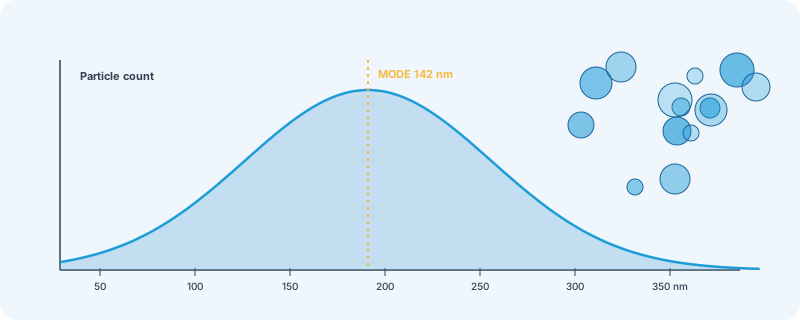
A particle count is the easiest number to put on a Certificate of Analysis. It is also the easiest one to reproduce while saying nothing meaningful. Two preparations of extracellular vesicles (EVs) at 1×10⁹ particles per milliliter can differ in size distribution, marker composition, source-cell identity, and cargo by enough to drive opposite results in the same downstream assay. Reproducibility is not a particle count.
For research labs working with EV preparations under a multi-month protocol, the question is not "what does this lot contain?" — it is "what would I have to know to be sure this lot is equivalent to the one I qualified six weeks ago?" That equivalence question is what a useful per-lot characterization envelope answers.
The minimum per-lot envelope
The MISEV (Minimal Information for Studies of Extracellular Vesicles) guidelines from the International Society for Extracellular Vesicles (ISEV) are the working consensus standard. A useful per-lot data envelope, in our view, includes:
- Particle count and size distribution by Nanoparticle Tracking Analysis (NTA) or equivalent. Report mean, mode, and D90 size.
- Tetraspanin marker panel — at minimum CD9, CD63, CD81. Reported by Western blot or bead-based flow.
- Source-cell identity — donor identifier, cell line, passage number at harvest.
- Endotoxin testing by LAL, with a stated target threshold (we use <0.5 EU/mL).
- Sterility — USP <71> or equivalent in-process check.
- Mycoplasma negativity on the source cell line.
- Storage and handling history — how was the lot frozen, how many freeze-thaw cycles, what shipping method.
What a particle count alone cannot tell you
Two EV preparations with identical NTA particle counts can differ in:
- Particle-to-protein ratio. A high-protein preparation may contain co-isolated soluble factors that drive the result you attribute to the EVs.
- Source biology. EVs from MSC supernatant are not interchangeable with EVs from cord-blood plasma, even when both are CD9/CD63/CD81 positive.
- Tetraspanin profile. CD63-dominant vs CD81-dominant populations have different cargo bias.
- Subpopulation composition. "Exosome" is an operational definition; isolated populations contain microvesicles, ectosomes, and apoptotic bodies in ratios that depend on the isolation method.
Practical advice for qualifying a supplier
Before you commit a multi-month protocol to a supplier, ask for the following from a single representative lot:
- The COA (everything in the envelope above)
- The isolation method (TFF + SEC vs ultracentrifugation vs precipitation kit) — this drives the subpopulation composition more than anything else
- Lot-to-lot variability data across at least three previous lots from the same source-cell program
- Storage stability data — how does the preparation perform after 1, 3, 6 months at the recommended storage temperature
Where ExoBioCorp fits
We are a research-supply distributor. The COA and characterization envelope you receive on every ExoBioCorp shipment is the manufacturer's — we add no chemistry. What we add is the documentation discipline (lot-traceable, searchable in your account), the cold-chain validation, and the supplier-selection step that excludes manufacturers whose envelope does not meet the bar above.
For research-supply purposes that is enough. For programs that intend to translate to a clinical pathway, additional characterization (potency assay relevant to the intended mechanism, stability under the planned manufacturing process, GMP comparability) becomes necessary, and a research-grade preparation is the wrong starting point.