
A practical primer on MSC identity and the ISCT minimum criteria
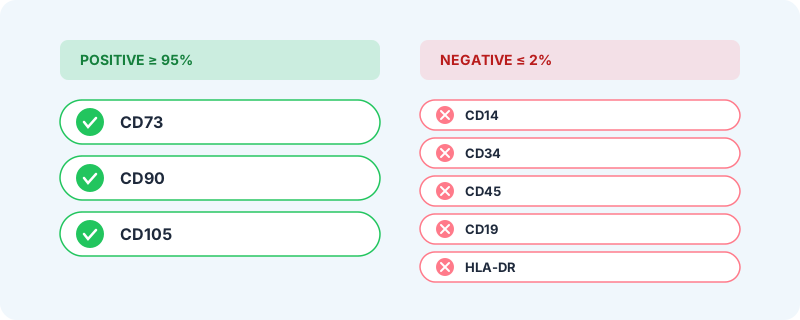
The 2006 position paper from the International Society for Cell & Gene Therapy (ISCT) — Dominici et al., Cytotherapy 8(4):315-7 — set out the minimum criteria for what counts as a mesenchymal stem cell (or, more precisely per the same group's 2019 update, a mesenchymal stromal cell) preparation. Twenty years later it is still the working definition that supplier COAs reference. Here is what each of the three criteria actually requires.
Criterion 1 — plastic adherence under standard culture conditions
Plastic adherence is necessary but not sufficient. It is the easiest of the three criteria to satisfy, and most contaminating cell types in a primary isolate will adhere too. What it tells you on a COA is that the supplier successfully isolated and propagated cells in tissue-culture-treated plasticware in standard medium — not that the population is pure.
A useful supplement: passage number at harvest. MSC functional characteristics drift with passage. Early passages (P1–P3) preserve more of the original donor heterogeneity and trilineage potential; late passages (P6+) tend to senesce, lose differentiation capacity, and shift surface marker expression. A characterized preparation should disclose passage at vialing.
Criterion 2 — surface marker panel
The defined surface marker panel — measurable by flow cytometry — is the most actionable identity criterion. The minimum:
- Positive (≥ 95%): CD73, CD90, CD105
- Negative (≤ 2%): CD14 (or CD11b), CD34, CD45, CD19 (or CD79α), HLA-DR
The negatives are at least as important as the positives. CD45 negativity excludes residual hematopoietic contamination. CD34 negativity (in human BM-MSC) excludes endothelial and primitive hematopoietic cells. HLA-DR negativity reflects an unactivated state; an inflammatory environment can up-regulate HLA-DR on otherwise-bona-fide MSCs, so a single positive measurement is not necessarily disqualifying — context matters.
A useful COA reports both percent-positive cells per marker and median fluorescence intensity. Two preparations that both report "CD90 positive 98%" can have very different MFIs, which can drive different functional behaviors downstream.
Criterion 3 — tri-lineage differentiation potential
Demonstrated capacity to differentiate, in vitro, into osteoblasts (Alizarin Red staining for mineralization), chondroblasts (Alcian Blue for proteoglycan-rich matrix or toluidine blue for sulfated GAGs), and adipocytes (Oil Red O for intracellular lipid). This is the criterion most often satisfied by reference and not by per-lot testing — costly, time-consuming, and qualitative.
What you can reasonably ask a supplier for: tri-lineage characterization data on the master cell bank or on a representative lot from the same donor / donor pool, plus a documented procedure that confirms the characterization carries through subsequent banks under the same protocol.
What ISCT does NOT cover
The 2006 criteria are necessary minimums. They are not sufficient for every research question. Common gaps:
- Potency. ISCT identity does not predict mechanism-specific function (immunomodulation, paracrine secretome, mitochondrial transfer activity). For potency-relevant work, an additional functional assay is needed.
- Tissue-of-origin signatures. BM-MSC, AD-MSC, and UC-MSC all satisfy ISCT criteria yet differ in transcriptional profile, cytokine secretion, and differentiation bias.
- Donor variability. Even within a tissue source, donor age, sex, and health status drive functional variability that the identity panel does not capture.
- Immunogenicity in allogeneic context. The HLA-DR negativity criterion captures one axis; full HLA typing and immunoreactivity testing is a separate workup.
Practical recommendation for research-supply selection
For an MSC preparation entering a research protocol, ask the supplier for:
- The full ISCT-aligned characterization panel on the specific lot (not just the master bank)
- Donor identifier, age, sex, and tissue source
- Passage number at vialing
- Any potency-relevant functional data the supplier has (secretome panel, immunosuppression assay, mitochondrial activity)
- Documented donor eligibility per 21 CFR Part 1271 Subpart C where the source applies
Where ExoBioCorp fits
The MesenCore line distributes BM-MSC, AD-MSC, and UC-MSC populations characterized to the ISCT criteria above. Per-lot data is included on every COA, and donor eligibility records are held for every donor source consistent with the manufacturer's 21 CFR Part 1271 Subpart C documentation. For research only — not for clinical-cell-therapy manufacturing.